
Where Does the Traditional Project Manager Fit in the New Agile World?
Is the Project Manager role obsolete? Let's find out.

I’ve led PMOs across complex environments, and one question keeps coming up when organizations shift to agile: what happens to the Project Manager?
Because in the traditional world, the Project Manager is the center of gravity. They own the plan, manage timelines, track dependencies, and report status. They’re accountable for scope, cost, and time, and success is measured by how well the plan is delivered.
Then agile steps in and changes the game.
We move from delivering against a fixed plan to delivering value in increments. From control to empowerment. From outputs to outcomes. And in that shift, the responsibilities that once sat with one person don’t disappear… they split.
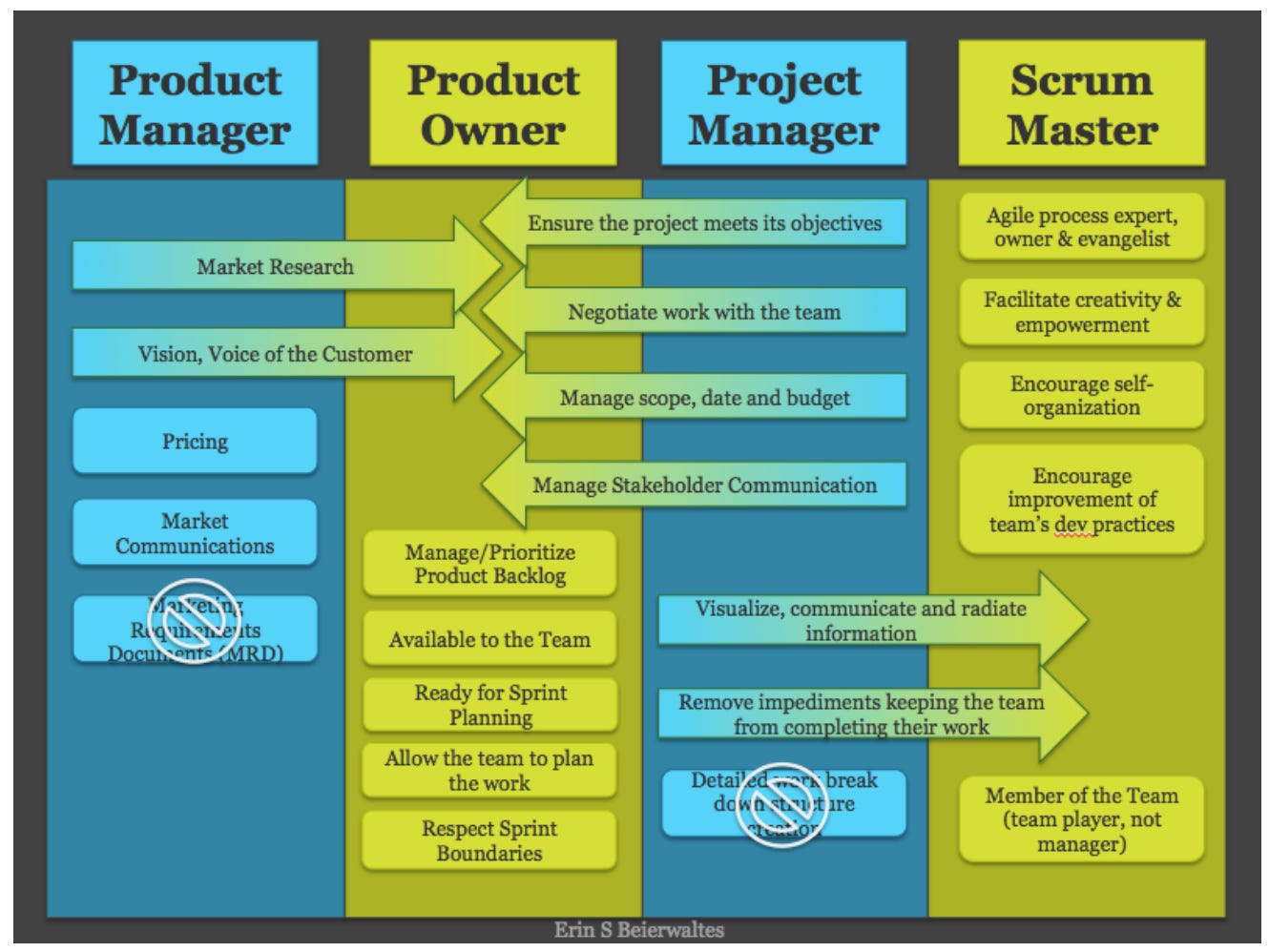
In a Scrum-based world, what used to be the Project Manager role is effectively unbundled into two distinct accountabilities: the Product Owner and the Scrum Master.
As Roman Pichler puts it so clearly, the Product Owner is responsible for the “what” – creating the right product – while the Scrum Master is responsible for the “how” – using Scrum the right way. And only when you get both right do you create sustainable success.
That distinction matters more than most organizations realize.
The Product Owner is focused on value and direction. They decide what gets built, in what order, and why. They represent the customer, the business, and the vision. They’re constantly making trade-offs to ensure the team is working on the highest value outcomes.
The Scrum Master, on the other hand, is focused on flow and effectiveness. They make sure the team is operating well, following agile principles, removing blockers, and continuously improving. They protect the team from noise and help create an environment where great work can happen consistently.
And then you have the team itself, a cross-functional group that owns delivery end to end. No handoffs, no silos, no waiting in queues. Just a team that can take an idea and turn it into something real.
This is one of the biggest shifts I’ve had to drive in PMO transformations. Moving from functional silos to true cross-functional teams. In the old world, work moves from one team to another, which slows things down and diffuses accountability. In agile, the team owns the outcome. That changes everything.
Now, one question I hear all the time is:
“Why can’t the Scrum Master and the Project Manager just be the same person?”
And on the surface, it sounds efficient. One person, one role, less overhead.
But in reality, it creates a fundamental conflict.
Because you’re asking one person to be responsible for both the what and the how.
You’re asking them to decide what needs to be delivered while also protecting how the team delivers it.
And under pressure, something gives.
In my experience, it’s almost always the “what” that wins. Deadlines, stakeholder demands, and business pressure start to override team health, quality, and good practices. The system slowly drifts back toward command and control, just wearing agile language on top.
That’s why the separation matters.
When you have a Product Owner focused on value and a Scrum Master focused on team health and process, you create a healthy tension. One is pushing for the right outcomes, the other is protecting the system that delivers those outcomes. Together, they keep the team balanced, focused, and sustainable.
That balance is what replaces the old Project Manager role.
So is the Project Manager obsolete?
Not exactly. But the role, as it existed, has been redefined and redistributed.
What I’ve seen, time and time again, is that great Project Managers evolve. They step into Product Owner roles, owning value and direction. Or they step into Scrum Master or Agile Coach roles, enabling teams and improving systems.
But trying to hold onto the old model, where one person manages everything, is where things start to break.
Because agile isn’t asking, “Who’s managing the project?”
It’s asking, “Are we building the right thing, and are we building it the right way?”
And the answer to that question is no longer one role.
It’s a partnership.
What’s the growth path for a traditional Project Manager?
There isn’t a single path forward, and that’s actually the opportunity.
A traditional Project Manager can evolve into a Product Owner, Scrum Master, Agile Coach, or program-level leader, depending on where their strengths lie. The skills don’t disappear, they shift. From managing timelines to owning value. From driving teams to enabling them. From controlling delivery to improving the system that delivers.
But staying in the exact same role, trying to operate the same way as before, is where things start to break down.
Agile doesn’t need someone to manage the work in the old sense. It needs people who can unlock it, shape it, and guide it in the right direction.
To your agility,
Gilli
P.S. 🌸 find time to talk about improving agility in your world, or read about me